|
2026 (21st) APMAA Annual Conference
Conference Dates: November
2026 (final dates to be confirmed)
Format:
Onsite
Venue: Tokyo Metropolitan University, Japan (official confirmation expected
soon)
bout | Tokyo Metropolitan University
(Video
Introduction of TMU)
 2026 Call for Papers
(March 2nd Draft Version)
2026 Call for Papers
(March 2nd Draft Version)
APMAA Communication Protocal for Memebrs (for Emails & Speech)
February 22, 2026
"No membership required to submit. Conference participation =
automatic membership."
|
The APMAA Annual
Conference brings together scholars, practitioners, and doctoral students from
across the Asia-Pacific region and beyond to exchange ideas, present
cutting-edge research, and strengthen international collaboration in management
accounting and related fields. The 2026 conference will continue APMAA’s
commitment to fostering a vibrant, inclusive, and globally engaged academic
community.
Further
details—including the call for papers, registration information, program
schedule, and accommodation guidance—will be released in the coming months.
We look forward to
welcoming you to Tokyo in 2026.
|
|
APMAA 2026 Schedule (Onsite
Format;Dates are Tentative) |
|
Day 1: Afternoon on
November 13,
2026 (Friday) |
Board Meeting (TBD) |
|
Day 2: November
14, 2026 (Saturday) |
Plenary Session,
Forums, Academic
Paper Sessions (2-1,2-2) (TBD) |
|
Day 3: November
15, 2026 (Sunday) |
Academic
and Doctoral Student Paper Sessions (3-1, 3-2, 3-3),
Forums (TBD) |
|
Day 4: November
16, 2026 (Monday) |
Company Visit
|
|
 APMAA 2025 Conference Program
(Uploaded on
Oct. 19, 2025)
APMAA 2025 Conference Program
(Uploaded on
Oct. 19, 2025)
2025 Book of Abstracts
(Uploaded on Oct.8, 2025)
APMAA2025
Proceedings Volume 1
(Only for the
2025 members: Password required)
APMAA2025
Proceedings Volume 2
(Only for
the 2025 members: Password required)
APMAA2025
Proceedings Volume 3
(Only
for the 2025 members: Password required)
PPT Guidelines for Presenters, Moderators, and Discussants
(for the Academic Paper Sessions),
Uploaded on Sep.29, 2025
PPT
Guidelines for Presenters, Mentors, and Moderators
(for the Doctoral Colloquium Sessions),
Uploaded on Sep.29, 2025 |
|
|
|
2026
Call for Papers
"No membership required to submit. Conference participation =
automatic membership."
APMAA’s scholarly
activities reflect the diversity and complexity of accounting in the
Asia‑Pacific region. Research contributions are broadly distributed
across three major pillars:
Management Accounting &
Performance Measurement (~40%)
Financial Accounting, Reporting & ESG Disclosure (~30%)
Internal Control, Governance, Ethics & Auditing (~30%)
APMAA 2026 invites submissions
across a wide range of accounting and management‑related topics that
align with these domains and the conference theme.
Primary Subject Areas (01–19) for Academic
Paper Sessions
APMAA’s academic paper sessions
welcome manuscripts that advance accounting scholarship through
diverse methodological approaches:
Empirical — case
studies, surveys, interviews, observations
Quantitative — modeling, simulations, statistical analysis
Conceptual — literature reviews, theoretical analyses,
conceptual modeling
Selecting Subject
Areas
Authors should designate
one primary subject area and may optionally select
one or two secondly subject areas to best represent their
manuscript.
01. AI and Analytics in Management
Accounting
Focus areas:
Algorithmic management, AI governance, NLP and LLM applications,
digital transformation, human–AI collaboration
Examples: AI‑assisted forecasting, real‑time
anomaly detection, digital twins, automated internal controls
Research opportunities: Governance, transparency,
and accountability implications of AI adoption in management
accounting and control systems
02. Costing and Performance
Measurement Systems
Focus areas:
ABC, TDABC, TCO, BSC, KPIs, real‑time dashboards
Examples: Service costing, sustainability‑adjusted
costing, cost allocation in digital platforms
Research opportunities: Capturing intangible value,
environmental costs, and digital externalities in cost and
performance systems
03. Budgeting and Planning Systems
Focus areas:
Beyond Budgeting, rolling forecasts, scenario planning,
participative budgeting, zero‑based budgeting
Examples: Agile budgeting,
sustainability‑integrated planning, AI‑enabled forecasting
Research opportunities: Designing budgeting systems
that support accountability, adaptability, and strategic agility
04. Strategic Management
Accounting
Focus areas:
Strategy–accounting integration, competitive intelligence, decision
support under volatility
Examples: Platform economics, pricing under data
externalities, risk–speed trade‑offs
Research opportunities: Forward‑looking tools that
anticipate market shifts and enable proactive strategic positioning
05. Innovation and
Intangible Asset Accounting (Strategic
Priority Track)
Focus areas:
Organizational capital, data assets, IP, human‑capital measurement
Examples: Innovation accounting frameworks, ROI of
analytics, capitalization policies
Research opportunities: Reducing the market–book
value gap through robust intangible‑asset measurement
06. Management Accounting in
Multinational Enterprises
Focus areas:
Cross‑border controls, transfer pricing, global dashboards, regional
coordination
Examples: International performance systems,
tax‑efficient structures, shared services
Research opportunities: Harmonizing global
decision‑making while accommodating local institutional differences
07. Management Accounting in
State‑Owned Enterprises, Public Sector, and NGOs
Focus areas:
Performance measurement, accountability, service quality under
resource constraints
Examples: University governance, healthcare cost
systems, outcome‑based budgeting
Research opportunities: Adapting private‑sector
innovations to public contexts while maintaining equity and
accountability
08. Management Accounting for SMEs
and Family Businesses
Focus areas:
Scalable systems, growth management, professionalization
Examples: Working‑capital dashboards,
succession‑planning controls, export‑readiness tools
Research opportunities: How digital democratization
enables SMEs to overcome resource constraints
09. Business Reporting and ESG
Focus areas:
ESG metrics, carbon and cost management, integrated reporting,
climate‑ and nature‑related disclosures
Examples: Sustainability assurance, internal carbon
pricing, double‑materiality assessments
Research opportunities: Designing decision‑useful
ESG metrics that link compliance with strategic value creation
10. Business Ethics and Internal
Control
Focus areas:
Ethical governance, integrity‑oriented controls, fraud prevention,
AI ethics
Examples: Algorithmic controls, fraud analytics,
whistleblower protection
Research opportunities: Control systems that
prevent misconduct while supporting psychological safety and
learning
11. Mathematical Models and
Computational Methods in Accounting
Focus areas:
Optimization, simulation, machine learning, analytical modeling
Examples: Cost optimization, Bayesian models,
causal inference, reinforcement learning
Research opportunities: Developing quantitative
methods that remain interpretable and actionable for practitioners
12. Comparative Management
Accounting (Strategic Priority Track)
Focus areas:
Cross‑country and cross‑regional comparisons of practices and
governance
Examples: Productivity paradoxes, institutional
influences on MA adoption
Research opportunities: Identifying structural and
institutional drivers of success or failure across regions
13. Management Accounting in
Islamic Business
Focus areas:
Sharia‑compliant controls, ethical finance governance, performance
systems
Examples: Profit–loss sharing metrics, ethical
investment screening, transparent management of zakat and waqf
Research opportunities: How faith‑based governance
enhances trust and stakeholder accountability
14. MA Education Renewal and
Human Capital Development (Strategic
Priority Track)
Focus areas:
PBL, experiential learning, analytics/ERP labs, AI literacy
Examples: Experiential course design, analytics
curricula, assessment of judgment and critical thinking
Research opportunities: Transforming accounting
education from content delivery to capability development
15. Management Accounting History
and Foundational Scholarship
Focus areas:
Historical evolution, institutional development, foundational
education research
Examples: Archival case studies, curriculum
evolution, biographies of practice leaders
Research opportunities: Using historical insights
to inform contemporary system design and reform
16. Auditing and Assurance
Services
Focus areas:
Sustainability assurance, AI‑driven analytics, integrated control
systems
Examples: Greenwashing detection, automated control
auditing, continuous auditing
Research opportunities: Regulatory sandboxes for AI
auditing and algorithmic accountability
17. Financial Accounting and
Disclosure
Focus areas:
Reporting quality, investor communication, links to management
control
Examples: Intangibles disclosure, narrative
reporting quality, earnings‑management detection
Research opportunities: How external reporting
requirements shape internal decision processes
18. Management Accounting for
Crisis Resilience and Adaptation
Focus areas:
Preparedness, response, recovery, resilience measurement
Examples: Scenario planning, resilience dashboards,
crisis cost management
Research opportunities: Building capabilities that
help organizations anticipate, absorb, and adapt to systemic shocks
19. Other Topics in Management
Accounting
Focus areas:
Emerging or cross‑cutting themes not covered above
Requirement: Authors must clearly articulate the
contribution and relevance to management accounting scholarship
We look forward to your
participation and contributions to making APMAA 2026 a successful
and enriching conference.
Prof. Dr. Susumu Ueno
Chief Gatekeeper, APMAA Paper Review Process
|
|
Tentative:
2026
General Guidelines for Authors
(Academic
Paper Sessions)
The
academic paper sessions at the APMAA Annual Conference remain a
cornerstone of the event, fostering scholarly exchange on a diverse
array of accounting topics. The session welcomes full-paper from a
faculty members (e.g., an assitant professor and senior lecturers)
Authors are encouraged to submit papers utilizing various
methodologies, including empirical (such as case studies, surveys,
interviews, and observations), quantitative (including modeling,
simulations, and statistical analysis), or conceptual (such as
literature review, theoretical analysis, and conceptual modeling)
approaches. |
|
Tentative:
2026
Guideline for Authors (Formatting and Template)
1.
All submitted manuscripts should report original, unpublished
research results.
2.
The official language of APMAA 2026 is English in both
writing and presentation.
If English is not your
mother
tongue
(first
language),
check your draft using a professional editor and/or
with a spelling- and grammar-matching application such as
Grammarly before submitting your manuscript.
You can download a free version of this application on a webpage and
install it on your PC.
If your document is
hard to read, we will decline it before sending it to our reviewer
(Desk
Reject).
3.
Manuscripts should follow the structure of a traditional research
paper, i.e.,
you will need to adjust your document to the
academic format
(If
not, Desk Reject).
An empirical research paper's typical organization is Title,
Abstract, Introduction, Literature Review, Methodology, Results,
Discussion, Conclusion, and References.
4.
Use Times New Roman font with
size 12, page size A4, and
single-spaced font.
5.
Abstract
should be 200-300
words
and placed preceding the text.
Show five keywords below the abstract.
The text should be over 5,000 but usually not exceed 10,000 words
(If
not, Desk Reject).
6.
The cover page should include the title of the paper, along with the
full names (first name, initials, and family name) of "all" authors,
their academic positions (e.g., Associate or Assistant
Professor, Ph.D. Candidate, etc.), and their affiliations
(capitalize the first letter of each word). Additionally, email
addresses for each author should be provided. Please clearly
indicate the corresponding author and include their phone number.
7.
To promote anonymous review, authors should not identify themselves
directly or indirectly in their writing.
8.
A
Single author should not use the pronoun
"we."
Referencing should
follow the APA style
(http://www.apastyle.org).
9.
Each author registering for the conference is
limited to two
(2)
full-length
paper submissions
(including
co-author
papers)
for the Academic Paper Sessions.
10.
Authors who received a
"Minor
Revision"
or
"Major
Revision"
notification are expected to resubmit their revised
(final)
manuscripts before a specified date
(the
temporal deadline is August 20)
to get an
"Accept"
notification by September 1.
Our review team engages in review on a first-come-first-served
basis.
11. All
authors of accepted manuscripts must submit their camera-ready
papers for inclusion in the Proceedings and abstracts for the
Book of Abstracts by the deadline of September 15, 2026. For
the conference proceedings, authors may choose between submitting a
full-length paper or an executive summary.
While we recommend submitting a full-length paper, the executive
summary is a suitable option for authors planning to submit their
work to academic journals. Executive summaries, typically 3–7
pages (approximately 1,500–2,000 words), are more detailed than
abstracts and provide a concise overview of the research, including
its purpose, methods, results, and conclusions, allowing readers to
fully understand the study based on the summary alone.
12. To attend and present their papers,
the presenter (the first author)
must register (pay the participation fee) for the Conference before
September 16, 2026.
CMT Guidelines for Authors and Reviewers, Edited on June 7, 2024
Guidelines for the APMAA2025 reviewers and gatekeepers. Edited on
April 25, 2025
|
|
2026
Review Questions
(Tentative, Important to all authors)
1. * (Author
Status Confirmation)
The Academic Paper Sessions welcome submissions from faculty members
(e.g., Assistant or Associate Professors) and other qualified
researchers. Does the submission clearly indicate the academic or
professional status of all authors? Please confirm that all authors’
titles are listed on the cover page.
2. * (Conflict
of Interest Declaration)
I, the reviewer, hereby confirm that I have no conflict of interest
with the author(s) of this submission. I am a faculty member (e.g.,
Associate Professor or Assistant Professor) affiliated with a
different institution.
3. * (Research
Questions and Structure Assessment)
Are the research questions clearly defined and articulated? Does the
paper adhere to a proper academic structure, including sections such
as Abstract, Introduction, Literature Review, Methods, Results,
Discussion, Conclusion, and References?
4. * (Formatting
Compliance)
Please confirm that the paper’s style, layout, structure, and font
comply with the APMAA Formatting Guidelines for Authors. These
checks are essential to ensure smooth editing of the Book of
Abstracts and the Conference Proceedings.
Please ensure that the Abstract falls within the range of 200 to 300
words, verify that the paper includes 5 keywords, and confirm that
the total text length is 5,000 to 10,000 words.
If any of these criteria are not met, please "withhold acceptance of
the paper" until the author addresses these deficiencies.
5. * (Title
and Abstract Quality)
Please evaluate whether the title and abstract are appropriately
specific and concise, and whether they clearly indicate the scope of
the paper. Also check that the abstract meets the following
requirements:
1. Clearly states the research purpose or problem and its
significance.
2. Summarizes the theoretical background or framework.
3. Describes the research methodology (e.g., data, analysis
methods).
4. Highlights the main findings or results.
5. Explains the conclusions and implications of the study.
6. Falls within 200–300 words and is written in clear, standalone
English (no citations, tables, or unexplained abbreviations).
If these conditions are not satisfied, please request that the
author revise the abstract and/or title before acceptance.
6. * (Language
Quality)
Please assess whether the paper is written in clear, correct, and
professional English. Check that:
1. Sentences are grammatically correct and free from typographical
errors.
2. The writing is concise, coherent, and easy to follow.
3. Technical terms are used appropriately and consistently.
4. The tone is academic and objective, avoiding informal or
conversational expressions.
If the paper contains significant language problems that hinder
understanding, please withhold acceptance until the author revises
and improves the English.
7. * (Literature
Review and Theoretical Background)
Please evaluate whether the paper provides a comprehensive and
up-to-date review of relevant literature and presents a clear
theoretical foundation for the study. Check that:
1. The literature review identifies key studies and debates relevant
to the topic.
2. The research gap or problem is clearly articulated based on prior
work.
3. The theoretical framework is logically developed and supports the
research objectives.
4. Citations are accurate, current, and properly formatted according
to APMAA guidelines.
If the literature review is outdated, incomplete, or lacks clear
theoretical grounding, please request revision before acceptance.
8. * (Analytical
Soundness)
Please evaluate whether the analytical techniques used in the paper
are appropriate, rigorous, and correctly applied. Check that:
1. The chosen methods or models are suitable for the research
questions and data.
2. The analysis process is described clearly and can be replicated.
3. Assumptions, variables, and procedures are logically explained
and justified.
4. The interpretation of results is consistent with the data and
methods used.
If the analytical techniques appear weak, inappropriate, or
insufficiently explained, please withhold acceptance until the
author provides clearer justification or revises the analysis.
9. * (Accuracy
of Numerical Data)
Please examine whether the numerical data presented in the paper are
accurately computed and logically consistent. Check that:
1. All calculations, tables, and figures are free from numerical or
typographical errors.
2. The data sources are clearly identified and appear reliable.
3. Statistical analyses or quantitative results are correctly
applied and interpreted.
4. Reported numbers in the text, tables, and figures are consistent
with each other.
If you find discrepancies, miscalculations, or unclear data
presentation, please request correction before acceptance.
10. * (Tables
and Figures)
Please confirm that all tables and figures are appropriately
referenced within the text and that each is clearly presented and
properly formatted. Check that:
1. Every table and figure is numbered and cited in the text in
logical order.
2. Titles, captions, and labels are clear, concise, and accurately
describe the content.
3. Tables and figures are readable, consistent in style, and follow
the APMAA Formatting Guidelines for Authors.
4. Units of measurement, symbols, and abbreviations are used
consistently and correctly.
If tables or figures are unclear, inconsistent, or not properly
referenced, please request a revision before acceptance.
11. * (Conclusions
and Alignment with Research Questions)
Please evaluate whether the conclusions directly and adequately
address the research questions stated in the paper. Check that:
1. The conclusions are consistent with the study’s objectives,
results, and analysis.
2. They are clearly supported by empirical findings (if available)
or by sound logical reasoning throughout the paper.
3. The conclusions summarize the key insights and highlight the
theoretical and/or practical implications of the research.
4. Overgeneralization or claims not supported by evidence are
avoided.
If the conclusions are weak, unclear, or not substantiated by the
results or reasoning, please request revision before acceptance.
12. * (References
and Citations)
Please check whether all sources of ideas and information are
properly cited and acknowledged throughout the paper. Verify that:
1. In-text citations correspond accurately to the reference list.
2. The reference list is complete and formatted according to the
APMAA Formatting Guidelines for Authors.
3. All quoted, paraphrased, or adapted materials are properly
attributed to their original sources.
4. The cited literature is relevant, credible, and up to date.
If citations are missing, incorrect, or incomplete, please request a
revision to ensure full academic integrity and consistency.
13. * (Conceptual
Advancement)
Please assess whether the paper attempts to make a conceptual
advance in its field. Check that:
1. The paper proposes new ideas, models, frameworks, or
interpretations that extend existing knowledge.
2. The conceptual contribution is clearly explained and logically
developed.
3. The work demonstrates original thinking rather than merely
applying established concepts.
4. The proposed advancement is relevant and meaningful to management
accounting and related disciplines.
14. * (Overall
Assessment Guidelines)
Please evaluate the paper comprehensively based on the criteria
above and assign one of the following statuses:
Rejected – The paper contains serious flaws that are unlikely to be
resolved through revision. It is not eligible for 2025 presentation.
Major Revision – The paper shows potential but requires substantial
improvement in content, analysis, or structure. A revised version is
due by August 15 (tentative), with a final decision by September 1.
Minor Revision – The paper is fundamentally sound and only needs
minor, non-critical revisions. No re-review will be required.
Accepted – To be recommended only if the paper is strong in all
aspects and requires no changes. Acceptance at this stage should be
rare.
I recommend that this paper be assigned the status of:
15. * (Reviewer Comments)
Please provide concise comments (approximately 100–200 words)
summarizing your evaluation of the paper. Your comments should
highlight the paper’s strengths, weaknesses, and overall
contribution.
If your recommendation is not “Accepted,” please include specific,
constructive, and actionable suggestions to help the author revise
the paper for acceptance. Indicate which areas require
improvement—such as clarity of argument, literature coverage,
methodological rigor, data analysis, or presentation quality—and
provide clear guidance on how to address these issues.
Your feedback should be professional, supportive, and focused on
helping the author enhance the paper’s quality and readiness for
publication. |
|
How to submit your research papers to the 2026 APMAA
Paper Submission
site
(The Submission Deadline is July 15, 2026)
APMAA2026
CMT
site opened on May 1.
We
employ the
Conference Management Toolkit
(CMT)
that Microsoft Corporation provides to manage submitted
papers.
If
you are new to CMT, please create your account by
registering your ID (Email) and Password in the CMT system (Conference
Management Toolkit - Create New Account)
before submitting your paper. If you have a CMT account, you
can log in to
APMAA2025
CMT
with this account at
Conference Management Toolkit - Login.
Please click "Create new submission" in your Author console
and select
"Academic
Paper Sessions.
CMT Guidelines for Authors and Reviewers, Edited on June 7, 2024
|
MS-CMT Structure of the
APMAA2026
(Track
1)
Academic Paper Sessions
→
Primary subject areas
(14)
→
Secondary subject areas
(Track
2)
Other (Plenary
Session, Forum,
and
Doctoral Seminar Speakers)
(Track
3)
Organizers' Practice Track (Solely for
the use of the Organizer) |
Edit the
"Create
New Submission"
page and submit your manuscript. Please select an
appropriate subject area by clicking a primary subject area
button for an Academic Paper Sessions paper.
We recommend you click a secondary subject area button when
you find an additional relevant area.
Please ensure your submission meets the conference's
guidelines for accepting scholarly papers. The
Paper Submission Deadline is July 15, 2026.
"The Microsoft CMT service was used for managing the
peer-reviewing process for this conference. This service was
provided for free by Microsoft and they bore all expenses,
including costs for Azure cloud services as well as for
software development and support."
Preparing a 2026 Proceedings (Camera-ready) Paper
For your references:
2025 Book of Abstracts
(Uploaded on Oct.8, 2025)
APMAA2025
Proceedings Volume 1
(Only for the
2025 members: Password required)
APMAA2025
Proceedings Volume 2
(Only for
the 2025 members: Password required)
APMAA2025
Proceedings Volume 3
(Only
for the 2025 members: Password required)
PPT Guidelines for Presenters, Moderators, and Discussants
(for the Academic Paper Sessions),
Uploaded on Sep.29, 2025
PPT
Guidelines for Presenters, Mentors, and Moderators
(for the Doctoral Colloquium Sessions),
Uploaded on Sep.29, 2025
|
|
Subject: Acceptance Notification – APMAA 2025 Academic Sessions
(Paper ID)
Dear Author,
We are pleased to inform you that your
manuscript titled "{Submission.Title} (Paper ID: {Submission.Id})
has been accepted for presentation at the APMAA 2025 Academic
Sessions.
While your paper has been accepted, we
kindly ask that you carefully consider the reviewers' comments once
again when preparing your final camera-ready version. You may access
the reviewers' feedback via the "View Reviews" option in your Author
Console.
Please note that the 2025 Book of Abstracts
and Conference Proceedings will be compiled directly from the file
you upload as your camera-ready Submission. Therefore, the version
you upload—whether a full-length paper or an executive summary—must
be final and publication-ready.
🔹
Key Instructions for Your Camera-Ready Submission
1. Submission Deadline
All camera-ready files must be submitted by September 15, 2025.
Authors must also complete their conference registration by this
date.
2. Full-Length Paper or Executive Summary
You may choose to submit either of the following:
A full-length paper (5,000–10,000 words), or
A camera-ready executive summary (3–7 pages or approx. 1,500–2,000
words) if you intend to publish your full paper in a journal.
In either case, you must also submit an
abstract (200–300 words) for inclusion in the Book of Abstracts.
3. Formatting Requirements
Please format your Submission according to the official "2025
Guideline for Authors (Formatting and Template)", available at:
https://s-ueno.sakura.ne.jp/APMAA_asia/APMAA2025_Malaysia_Conference.htm
Key formatting points:
Font: Times New Roman, 12-point
Line spacing: Single
Abstract length: 200–300 words
Language: Clear, grammatical English
Author names and affiliations must follow the title after two
lines
4. Presentation Requirement
Only papers with a submitted full-length version or executive
summary will be scheduled for presentation.
The presenting Author must register by September 15, 2025.
Please email us at
ueno@konan-u.ac.jp to inform
us of:
1. Paper ID
2. The name and country of the presenter, and
3. Whether the presentation will be in person or online
📝
Additional Details: Preparing Your Submission
➤ What is an Abstract?
An abstract is a concise overview of your research, covering key
elements such as:
Topic and research questions
Participants or context
Methodology
Results and analysis
Conclusions and implications
Your abstract must be:
A single paragraph of 200–300 words
Clear, self-contained, and scholarly
Accurate and unbiased, reflecting the full paper or executive
summary
➤ What is a Camera-Ready File?
This is the final version of your paper that will be published in
the 2025 Conference Proceedings and Book of Abstracts.
Please upload it as a Microsoft Word document to the "Camera-Ready"
column in the CMT system. No further editing will be done after
upload.
📌
Important Reminders
Registration and Payment: You will be
notified when the official registration and payment site opens.
Please wait for instructions before making any payment.
Letter of Invitation: If you require a visa or travel funding,
please contact Prof. Dr. Normah Omar at
normah.omar@gmail.com
to request a Letter of Invitation.
Presentation Schedule: A preliminary presentation schedule will be
posted several times on the APMAA 2025 website before being
finalized.
|
|
Conference Venue:
Minami Osawa Campus
of
Tokyo Metropolitan University (TMU)
About Tokyo
Metropolitan University
Tokyo Metropolitan
University is the only university operated directly by the Tokyo
Metropolitan Government. Leveraging this unique position, the
university provides an education that cultivates talent capable of
responding to rapid societal change, while advancing a wide range of
basic and applied research, including studies focused on the
challenges faced by major metropolitan regions. Through these
efforts, the university contributes to Tokyo’s development and helps
shape the future on a global scale.
download.html (PDF:
Minami-Osawa Campus map)
Contact
|
TMU International Center International Affairs Office
キャンパス・施設案内
::
交通アクセス
|
東京都立大学
(Access to the Minami Osawa Campus)
TMU_Access_Map_Eng.pdf
Tokyo Metropolitan University -
Wikipedia
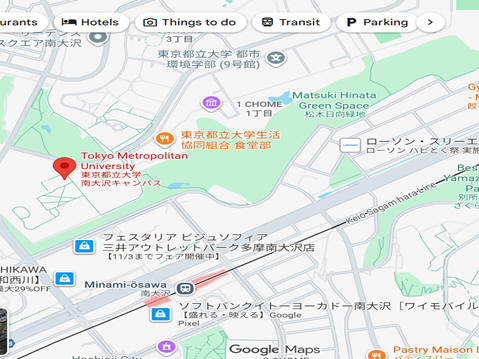
🚉 Access to Minami-Osawa Campus (Conference Venue)
From Minami-Osawa Station (Keio Sagamihara Line)
The Minami-Osawa Campus is a 5-minute walk
from the ticket gate of Minami-Osawa Station on the Keio
Sagamihara Line.
After exiting the ticket gate, the campus surrounded by greenery
appears on the right-hand side.
🚆 Access Routes (日本語併記)
From Shinjuku
Shinjuku → (Keio Line toward Hashimoto) →
Minami-Osawa
-
Local, Rapid, and Express trains all stop at Minami-Osawa.
-
If you board a train bound for Keio-Hachioji, transfer at
Chofu.
-
Example: Take the Keio Line Limited Express (toward Keio-Hachioji),
transfer at Chofu to the Keio Sagamihara Line Rapid/Express for
Hashimoto. Total travel time: approx. 30 minutes.
新宿 →(京王線 橋本行き)→
南大沢
普通・快速・急行はすべて南大沢に停車。
京王八王子方面行きの場合は調布で乗り換え。
特急(京王八王子方面行き)→ 調布乗換
→ 相模原線急行橋本行きで約30分。
From Shin-Yokohama
Shin-Yokohama → (JR Yokohama Line) → Hashimoto →
(Keio Sagamihara Line) → Minami-Osawa
Approx. 50 minutes.
新横浜 →(JR横浜線)→
橋本 →(京王相模原線)→
南大沢(約50分)
From Kawasaki
Kawasaki → (JR Nambu Line) → Inadazutsumi → walk to
Keio-Inadazutsumi → (Keio Sagamihara Line) → Minami-Osawa
Approx. 60 minutes.
川崎 →(JR南武線)→
稲田堤 →(徒歩で京王稲田堤へ)→
京王相模原線 → 南大沢(約60分) |
|
APMAA 2026 Annual Conference – Official Hotel (as of March 5, 2026)
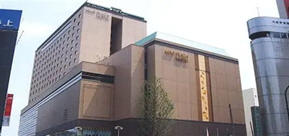
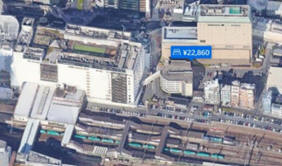
Keio Plaza Hotel Hachioji
(official confirmation expected soon)
Locations | Keio Plaza
Hotel Hachioji]
Keio Plaza Hotel
Hachioji is located near JR Hachioji Station, a major
transportation hub providing convenient access to central Tokyo and
Yokohama. The hotel is situated in western suburban Tokyo.
🚌 By Airport Limousine Bus (from Haneda Airport)
-
Time:
Approximately 95–125 min.
-
Fare:
Adult JPY 2,100 / Child JPY 1,050
Airport Limousine Buses from Haneda Airport arrive and
depart at JR Hachioji Station, which is approximately a
1-minute walk from the hotel.
このリムジンバスは
羽田空港 → JR八王子駅 の路線です。
🚆
By Train: From Haneda Airport to JR Hachioji Station
Route
①
Haneda Airport → (Keikyu Airport Line Limited Express to Aoto) →
Shinagawa
Shinagawa → (JR Yamanote Line) → Tokyo Station or Kanda Station
Tokyo / Kanda → (JR Chuo Line) → Hachioji Station
① 羽田
→(京浜急行
Keikyu Airport Line Limited Express to Aoto)→
品川
→(山手線)→
東京駅
or
神田
→(中央線)→
八王子
Route
②
Haneda Airport → (Tokyo Monorail Airport Rapid to Hamamatsucho) →
Hamamatsucho
Hamamatsucho → (JR Yamanote Line) → Tokyo Station or Kanda Station
Tokyo / Kanda → (JR Chuo Line) → Hachioji Station
② 羽田
→(東京モノレール
Tokyo Monorail Airport Rapid to Hamamatsucho)→
浜松町
→(山手線)→
東京駅
or
神田
→(中央線)→
八王子
✈️
From Narita Airport (Terminal 2) to JR Hachioji Station
Narita Airport Terminal 2 → (Narita Express) → Tokyo Station
Tokyo Station → (JR Chuo Line) → Hachioji Station
成田空港第2ターミナル
→(成田エクスプレス)→
東京駅
→(中央線)→
八王子駅 |
|
Key Activities |
Date |
|
CMT Application/Registration for APMAA Conference 2026 |
|
|
Distribution first edition call for paper |
|
|
Orientation/training CMT for gatekeepers & reviewers |
|
|
Open CMT Submission site |
May 1, 2026 |
|
Deadline for manuscript submission |
July 15, 2026 |
|
Participants' registration site opens |
|
|
Last day of acceptance/rejection notification |
Sept
1, 2026 |
|
Registration deadline for accepted papers |
Sept 16, 2026 |
|
Completion Book of Abstract |
|
|
Completion of tentative program |
|
|
Completion of proceedings |
|
|
Rehearsals for all presenters, moderators, discussants |
|
|
Conference Execution |
Nov. 13-16, 2026 |
Uploaded on January 12, 2026, by Prof. Dr. Ueno |

